Reconstructing the Erechtheion
Our reconstruction is as accurate as it is possible to be. Working from detailed CAD models which were drawn up by Dr Paul Blomerus, who referred to all the available information and checked measurements when inspecting in the field. We have created a version of the Erechtheion that adheres strictly to the CAD model, then continued adding decoration and fine detail on all the architectural features.
Our approach in reconstructing the Erechtheion.
Each detail of the Erechtheion 3D reconstruction has been checked by Alexandra Lesk before inclusion. Although the modelling is not yet complete - particular details may yet change when new research is implemented on our reconstruction thus providing a more accurate representation from antiquity (left: Dr Paul Blomerus CAD Erechtheion) There is some artistic licence in selecting the colours, the shape and size of the sacred olive tree, use and placement of stone or marble altars and other features.
The Pandroseion
The adjoining architectural structure to the Erechtheion was known as the Pandroseion. A number of conjectural reconstructions have been proposed for this and we have looked at three possible solutions. From a simple 'L' shape to the more substantial Ionic and the Doric style.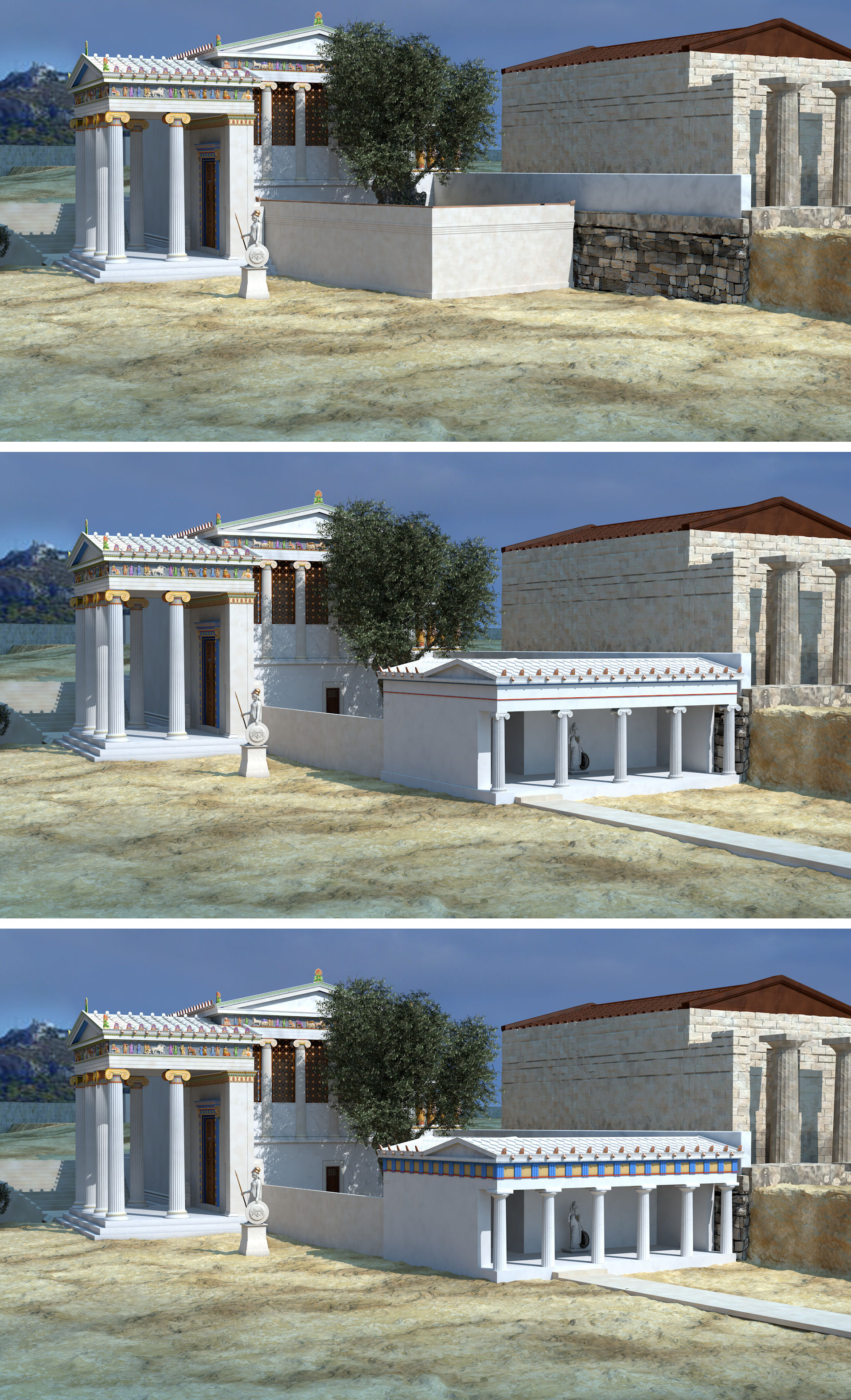
The model of the Erechtheion
is based on surveys and CAD
Data of the actual remains
of
the building on the
Acropolis.
Mechanical engineer
Dr Paul Blomerus kindly
provided the structural
CAD model which we
used as the basis for
our
3D reconstruction.