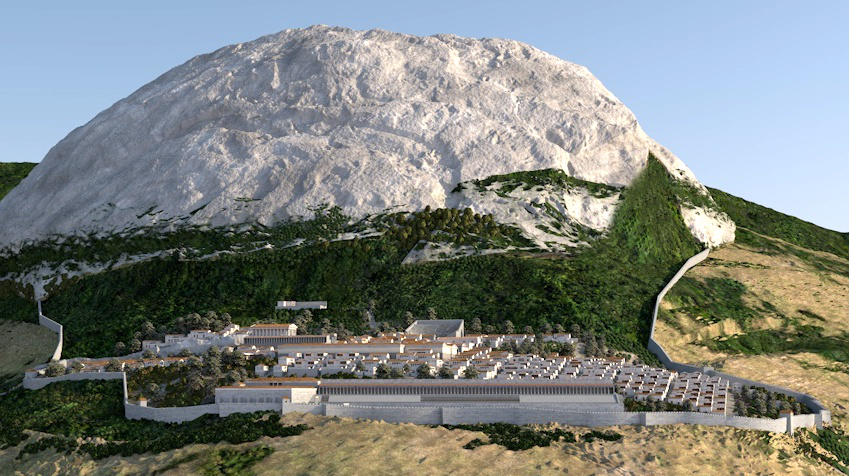
Anasynthesis continues our 'sketching series' with an overview of the city of Priene at the time of the late classical / Hellenistic period. Priene was a Greek city of Ionia and also a member of the Ionian League. It was dramatically located on a steep slope at the base of the Mount Mycale escarpment - north of what was then the course of the Maeander River.
The city was built on the sea coast, overlooking the Aegean Latmian Gulf. It was a steep terrace development renowned for its Hellenistic art and architecture. Priene contained sanctuaries dedicated to Zeus, Demeter and Kore, and, most importantly, the Temple of Athena - an Ionic order temple located above the Agora and dedicated to Athena Polias, It was the main temple in Priene and the construction was commissioned by Alexander the Great.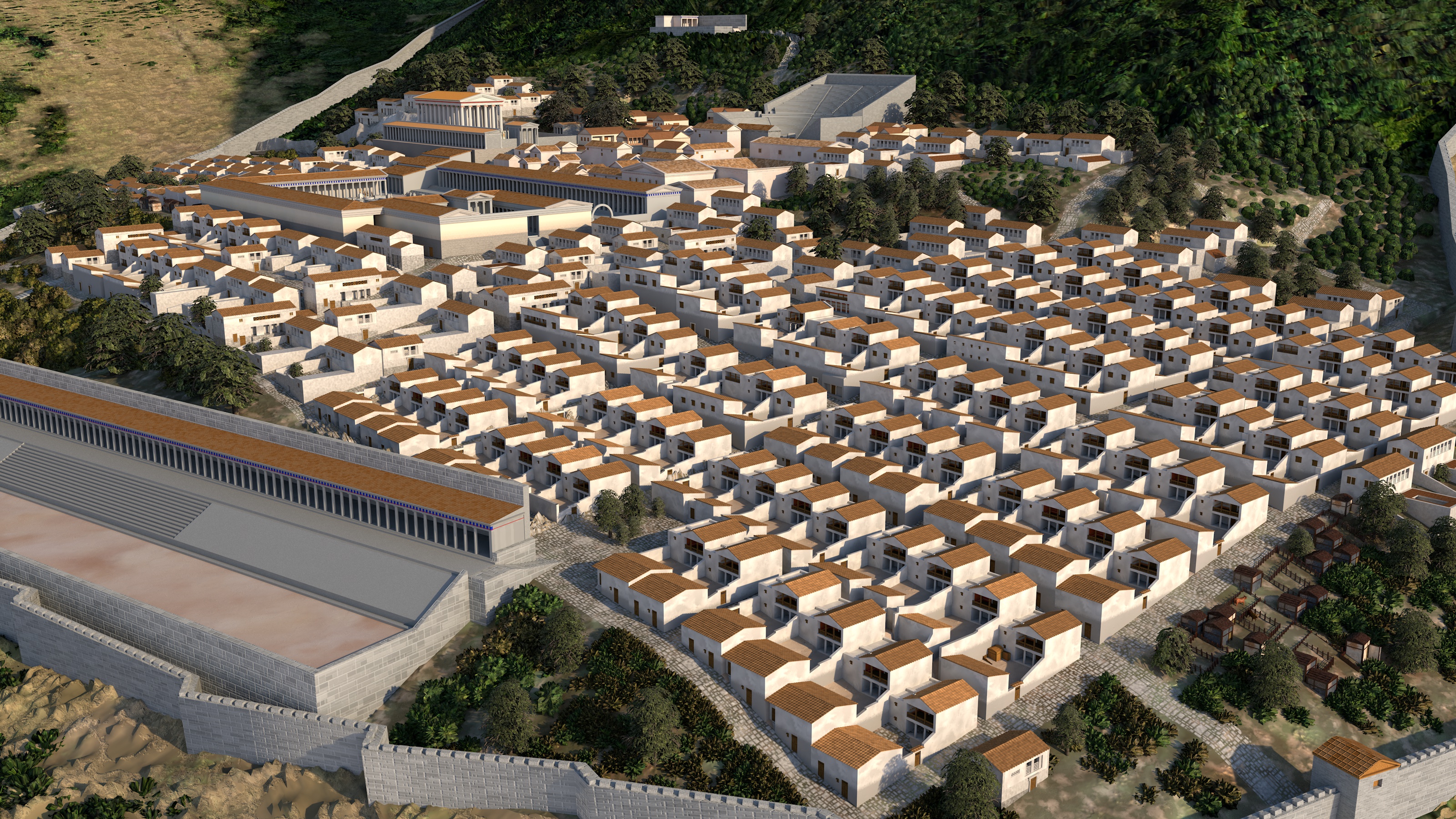
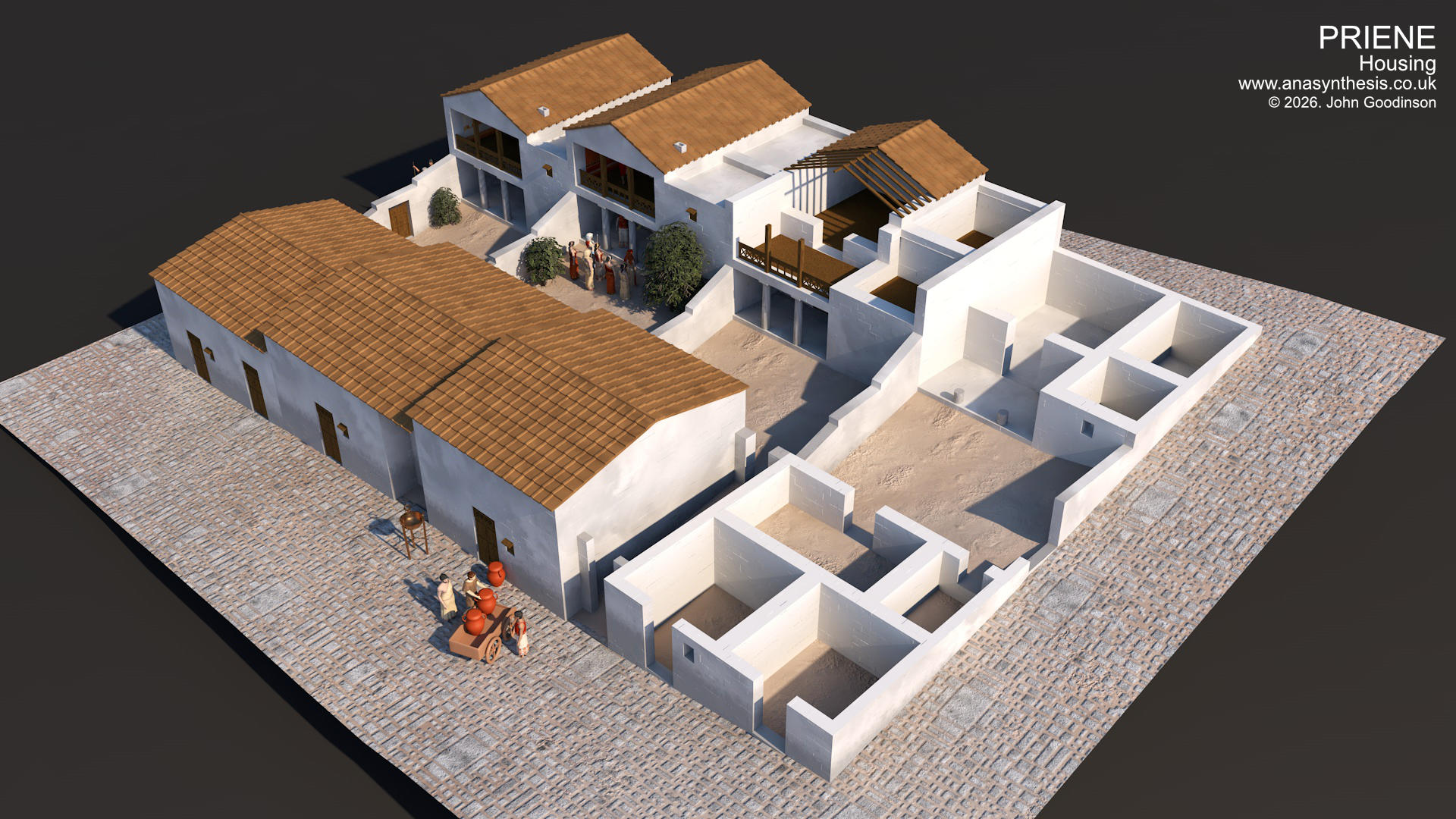
Our current reconstruction features the temple of Athena Polias, theatre, temple and sanctuary of Asclepius/Olympian Zeus, Agora with its colonnaded stoas, the Impressive Stadium and running track (extended in the Roman period) and finally the main feature of our reconstruction: individual town houses and living quarters. Construction of these individual dwellings was set out as a standard module. Each house was a two storied living area with an adjoining courtyard with ancillary buildings that were either storerooms, workshops or general shops, and access to a street. A 'building plot' contained 8 individual houses that occupied a single section of the 'civic grid' (insula).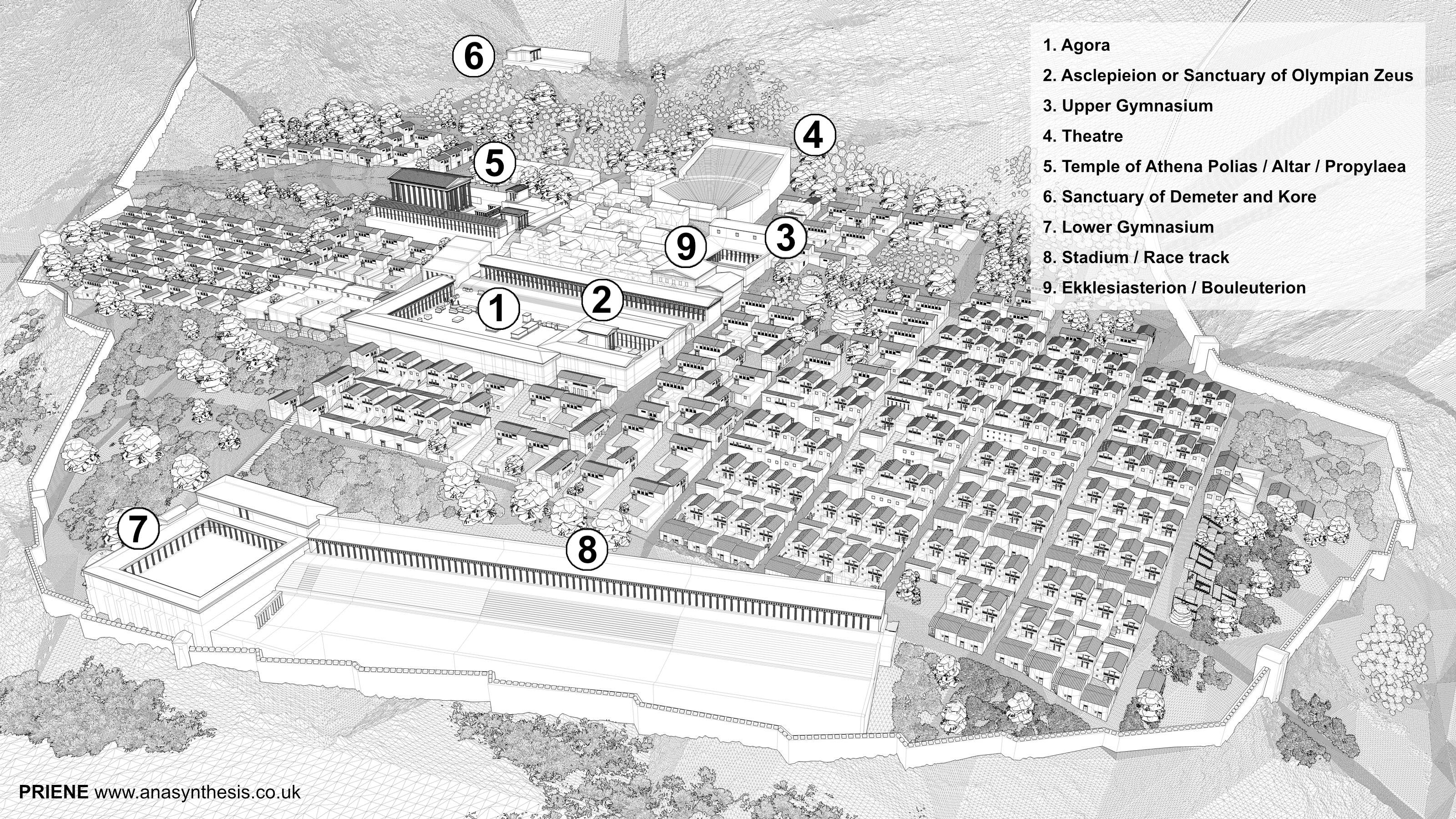
Below: the living quarters, with insulae of residences designed in a modular way, generate a sense of standardization. Nevertheless, the orientation of the houses and certain components of them, such as the peristyle court (forerunner of the atrium) and the porch-facades, indicate that sunlight and climatic conditions (winds, weather) were taken into serious consideration.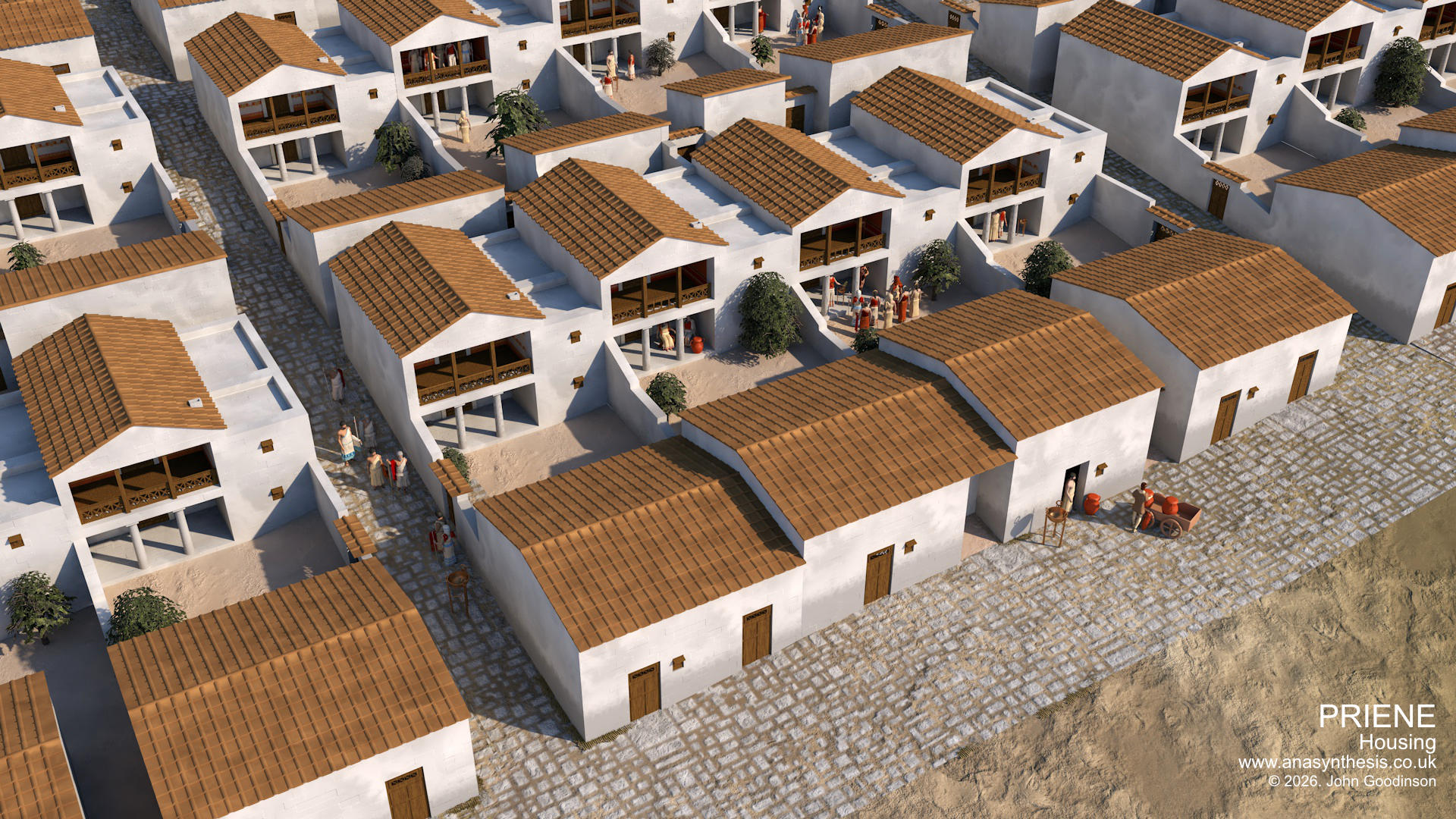
 In terms of urban planning, Priene was laid out with strict regularity, according to the grid pattern credited to Hippodamos and impacting the planning of cities for more than 2000 years. It seems as if Hippodamos sought to reflect harmony and rationality – the spirit of ancient Greeks - in the geometry of a city plan. Within a clearly framed and orderly arranged space he laid out checkerboard road networks, namely, streets intersecting at right angles, wherein civic spaces and public buildings stood out. By applying zoning with emphasis on neat spatial arrangement, axiality and accessibility, Hippodamos created nuclei, separating between public, sacred and private premises. Even the Theatre occupied an insula surrounded by streets. Priene, therefore, can be considered as the prime example, the hallmark of Hellenistic city-planning and urbanism; the latter denoting that an aesthetic dimension was attached to the city’s architecture and image, as a whole.
Moreover, at Priene, the carefully laid out urban landscape did not suppress the natural environment but, instead, obviated the involvement of both natural and human agents. Cases of visible untrimmed rock, reserved (building-free) public spaces and rock-carved steps showed the planners’ respect for geomorphology.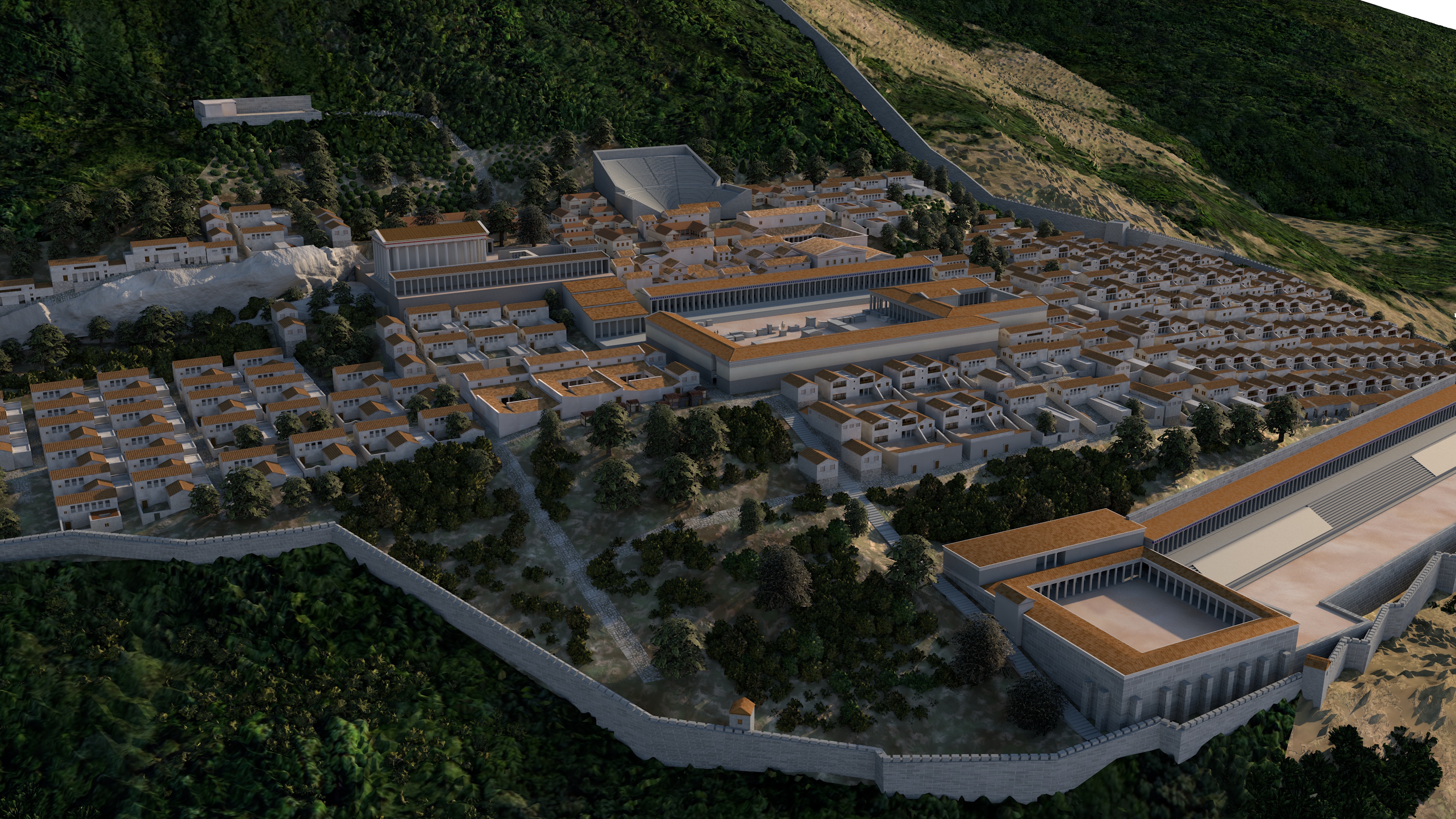
The city’s layout in successive graded terraces compromised the abrupt terrain inclination and rocky relief. In places, the natural bedrock had to be levelled, in order to accommodate the road arteries and to facilitate infrastructure projects, such as water supply and drainage. On the other hand, the founding of buildings in the bedrock was evaluated as a means of resilience and endurance in case of earthquakes.
The aim of this reconstruction then is to show the architectural style of the living quarters and homes of the civic population in the late Classical / Hellenistic times (shown above). Our model of Priene is based on the current archaeology available. The following publications (listed below) have informed decisions made on the layout and especially the architecture of the housing for the civic population.
Ref:
1.PRIENE. THEODOR WIEGAND und HANS SCHRADER PLATES AND ILLUSTRATIONS BERLIN GEORG REIMER. 1904.
2. Priene. Hellenic Studies (Hellenic Studies Series): Second Edition Illustrated 2006. Special thanks to architect John Svolos who was part of the publication team and who generously provided photography and advice on our reconstruction.
3. KURZE BESCHREIBUNG. VON MARTIN SCHEDE DEUTSCHES ARCHÄOLOGISCHES INSTITUT ABTEILUNG ISTANBUL. DIE RUINEN VON PRIENE. 1964 WALTER DE GRUYTER & CO. BERLIN.
4. W, Hoepfner - E. L. Schwandner. HAUS UND STADT IM. KLASSISCHEN GRIECHENLAND.1986 Deutscher Kunstverlag.